
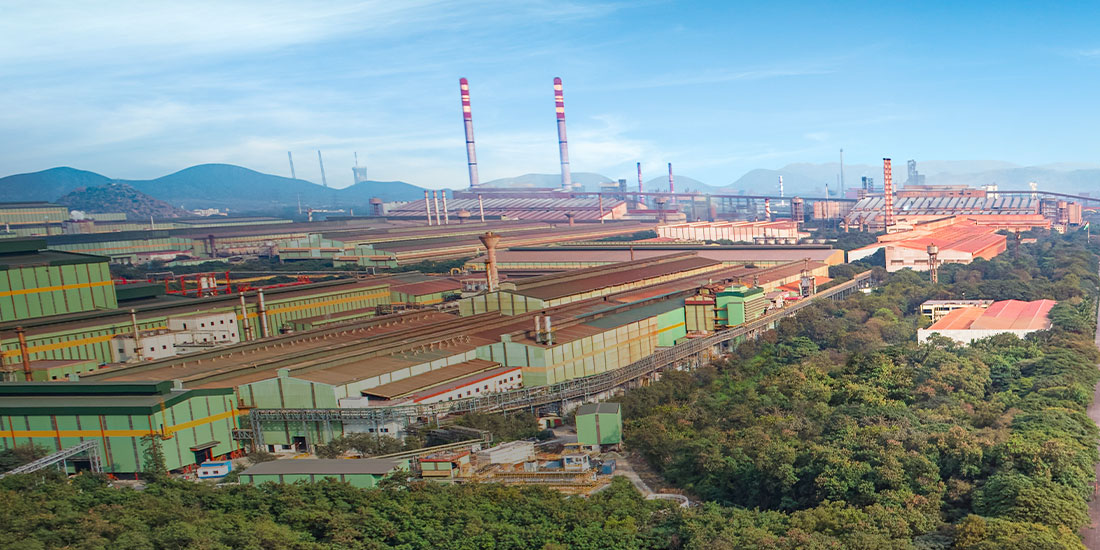
Shri OP Jindal’s life is often remembered for his extraordinary rise from a modest steel workshop to the foundation of the OP Jindal Group. For OP Jindal, industrial progress was not just about profit; it was about building a self-reliant India. This conviction sparked early within him. Chancing upon steel pipes stamped “Made in England” in the then Calcutta while on a walk, he resolved to build an indigenous manufacturing base, developing much of his plant machinery locally. This conviction led to the setting up of a manufacturing unit in Howrah in 1952. By 1960, Jindal India Ltd was making pipes along with steel buckets for the domestic market. Notably, only the welding machine was imported; every other equipment was designed and developed by Shri OP Jindal himself. This was the legacy from which the JSW Group, which today leads and grows a business portfolio spanning JSW Steel, JSW Energy, JSW Cement, and JSW Infrastructure, was born.
From his earliest days in Hisar, OP Jindal understood a simple truth: self-reliance begins with making the best possible use of what you already have. Whether it was scrap metal, water, machinery, or manpower, his instinct was always to ask how each resource could work harder, last longer, or be (re)used more intelligently. This mindset became the foundation for his pursuit of sustainable practices across the steel industry, cement manufacturing, energy production, and infrastructure development.
The theme of self-reliance was not just a national ideal but a practical requirement for OP Jindal. When he began his career, India relied heavily on imported technology, equipment, and even imported steel pipes. The young entrepreneur refused to accept this dependency as permanent.
In Hisar, inside his first small steel workshop, he began designing machines locally long before “indigenous manufacturing” became a national initiative. He believed that India’s industries could build their own future with their own hands. This conviction echoed through all the steel plants he later set up. Until today, this is a defining characteristic of the JSW Group.
His approach mirrored what JSW describes today as “Redefining India’s future through self-reliance”. It is the idea of being grounded in reducing import dependence, improving resource efficiency, and ensuring that industries grow without compromising the environment.
For OP Jindal, efficiency was always about more than technology. It was about people. He invested in training workers to understand machines deeply, solve problems quickly, and take ownership of their work. This discipline created teams that treated efficiency not as a mandated policy, but as a shared culture.
In the steel industry, where inefficiencies directly translate into higher costs and environmental strain, OP Jindal pioneered practices such as optimising production lines, designing smarter equipment, and strategically recycling scrap to reduce wastage. Many of the operational principles followed across the JSW Group today at JSW Steel, JSW Energy, JSW Cement, and JSW Infrastructure trace their origins to the systems OP Jindal put in place decades earlier.
Environmental consciousness was not yet mainstream when OP Jindal began advocating responsible growth. He recognised that future industries could not afford to expand without protecting the ecosystems around them.
His early sustainable practices included reusing materials whenever possible, emphasising energy-efficient steelmaking processes, and promoting circularity within steel plants. This was long before the global conversation around carbon footprints and climate responsibility gained momentum. His simple belief was that no resource should ever be wasted.
Steel plants generate slag as an industrial by-product, a material that, for decades, was largely treated as waste. JSW Group has been at the forefront of changing that narrative, turning what was once a disposal problem into a resource opportunity.
In January 2026, JSW Steel Limited's Salem Works entered into a strategic partnership with CSIR–Central Road Research Institute (CSIR-CRRI) to utilise steel slag in the construction of durable, eco-friendly roads in Tamil Nadu.
The collaboration, formalised under a sponsored research project titled ‘Development of Customised Steel Slag Valorisation Process for Techno-economic Conversion of EOF and LRF Steel Slag for Various Road Applications at JSW Salem Works,’ focuses on converting Electric Optimisation Furnace and Ladle Refining Furnace slag into processed aggregates suitable for bituminous road construction.
The initiative marks the first implementation of CSIR-CRRI's Steel Slag Road® technology in Tamil Nadu, a technology already successfully deployed across multiple states in India by leading steel producers. By reducing dependence on natural aggregates, minimising industrial waste, and lowering the carbon footprint of road construction, this project directly aligns with India's national priorities around resource efficiency and the circular economy.
For JSW, this partnership is more than an environmental commitment, it's a replicable model that could drive wider adoption of steel slag utilisation across the country's road infrastructure.
OP Jindal’s vision of self-reliance extended beyond steel. He understood that energy was the backbone of industrial progress. He knew that India would never be truly self-reliant if it remained dependent on fossil fuels or an unreliable power supply. This insight laid the foundation for what eventually became JSW Energy.
JSW focuses not just on growth but on creating meaningful impact by developing plants, ports, energy systems, and infrastructure that drive India’s progress. Even today, OP Jindal’s ‘India First’ ideology remains the cornerstone of the JSW Group’s philosophy. This legacy of purpose-driven leadership continues to guide JSW, transforming it from a family-led enterprise into a global leader in modern manufacturing.
Today, JSW Energy continues to expand hydropower, wind, solar, and hybrid renewable power projects, carrying forward OP Jindal’s commitment to sustainable practices and self-sufficient energy solutions.
As JSW Group Chairman Mr. Sajjan Jindal has stated, “Sustainability powers JSW Steel’s business vision. We realise that only by creating a sustainable future can we pave the way for our goal of a self-reliant India.”
Across ports and logistics hubs, the JSW Group implements rainwater harvesting, wastewater reuse systems, watershed management programmes, and clear targets to reduce freshwater consumption. These initiatives not only protect local ecosystems but also ensure that industrial growth does not create harsh effects on water-scarce communities.
Be it JSW Steel, JSW Energy, JSW Cement, JSW Infrastructure or JSW Paints, OP Jindal’s belief in balancing efficiency and environment continues to define operations, investments, and innovation across the JSW Group.
He proved that sustainable practices and industrial growth are partners, not rivals. He showed that a steel workshop can inspire an entire nation to dream bigger. He substantiated that a focus on renewable power projects can strengthen both industry and society. He made sure that water conservation at ports can protect communities for generations. And that responsible growth, rooted in self-reliance, redefines a country’s future. His relentless pursuit of self-reliance earned him the Lifetime Achievement Award in 2004 by the Bengal Chamber of Commerce & Industry.
His legacy remains an enduring reminder that efficiency is strength, environmental responsibility is progress, and sustainability and industrial growth are partners supporting one another.
View all newsBUSINESSES
JSW Steel JSW Energy JSW Infrastructure JSW Cement JSW Ventures JSW Paints JSW Realty JSW Defence JSW Dulux


