
Assam has long stood as one of India’s richest cultural regions, shaped by indigenous traditions, ancient craftsmanship, and living heritage passed through generations. Yet, despite its depth of artistic and historical legacy, the state has lacked a single large-scale institutional platform to preserve and present this story in a structured, globally accessible format.
Recognising this gap, the JSW Group has partnered with the Government of Assam to establish a world-class heritage museum in the state’s capital, Guwahati, designed to serve as a landmark institution for cultural preservation, education and global engagement. This initiative aims to bring Assam's cultural heritage into a modern framework, strengthening the long-term development of tourism in Assam.
By combining advanced museology with deep respect for the art and culture of Assam, this project positions Guwahati as a rising cultural capital.
A Turning Point: Why This Museum Matters Now
The Indian heritage museum dedicated to the preservation and global presentation of Assam’s history, textiles, and artistic traditions, is being developed on a 45,000 sq. ft. site at the sericulture farm in Khanapara, Guwahati. This strategically selected location is poised to strengthen Assam’s tourism while positioning the city among the best places to visit for cultural travellers. The Assam Government has allotted the land, while construction and full funding responsibilities rest with the JSW Group, reinforcing its role as a long-term cultural partner in the region.
At a time when tourism in Assam is expanding, and visitor interest in immersive cultural experiences is growing, this museum represents a structural shift, moving from fragmented heritage display to a permanent institutional platform marking an important development in the cultural heritage of Assam.
JSW Group’s Vision: Preserving Assam’s Heritage for Future Generations
The JSW Group has positioned this heritage initiative not as a standalone infrastructure project, but as a long-term cultural institution that safeguards identity, memory, and artistic legacy. The vision behind the museum reflects a strategic commitment to protecting the art and culture of Assam, while creating sustained platforms for learning, dialogue, and global engagement.
This vision has been clearly articulated by Mrs Sangita Jindal, Chairperson, JSW Foundation, in her statement:
“We have long believed in the power of art and culture to inspire communities. Through this collaboration, JSW is honoured to support the Government of Assam in creating a museum that will preserve India’s cultural heritage and offer a platform for global cultural engagement. The museum will stand as a testament to our shared heritage and artistic devotion.”
Inside the State-of-the-Art Museum: What Visitors Can Expect
The proposed museum is being developed as a fully immersive, technology-driven cultural institution designed to meet international museological standards. The infrastructure has been planned with climate-control systems, conservation protocols, and international museological standards to ensure the safe display and preservation of rare artefacts.
Unlike conventional displays, the Guwahati museum will use immersive projection, sound mapping and interactive installations to showcase the art and culture of Assam in a way that appeals to both younger and international audiences. The intention is to transform passive viewing into active cultural participation, ensuring that the cultural heritage of Assam becomes a lived experience rather than a static archive.
The architectural intent of the project has been articulated by Mr Abin Chaudhuri, architect of the proposed museum, who during the announcement of the museum stated:
“Designing a museum for the Vrindavani Vastra is both an honour and a responsibility. Our vision is to create a space that balances reverence and modernity where the architecture itself pays homage to the textile's devotional essence while providing the most advanced conservation facilities. Beyond housing the (Vrindavani) Vastra, this museum will also give Guwahati a world-class exhibition venue that can host international exhibitions, bringing the global arts community closer to Assam.”
Celebrating the Art and Culture of Assam Through Experiential Exhibits
A central focus of the museum is to bring the art and culture of Assam to life through experiential storytelling. Planned exhibits include rare textiles, indigenous craft traditions, tribal art, classical dance archives and music evolution galleries.
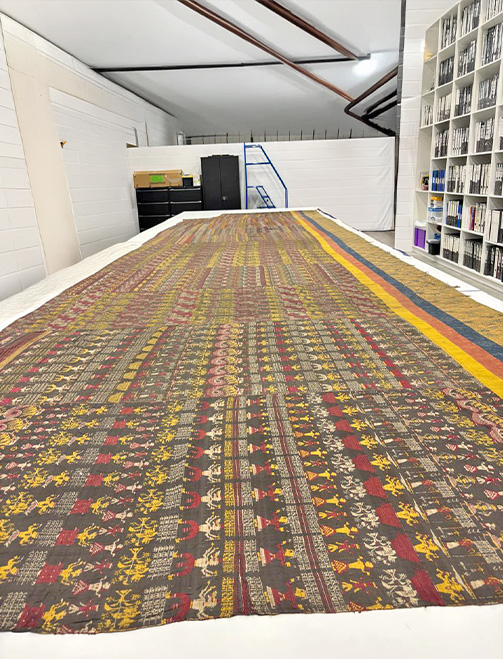
The first exhibit the museum will display is the Vrindavani Vastra, the 17th-century devotional textile created under the guidance of Srimanta Sankardeva and preserved at the British Museum in Reading, UK. The British Museum has entered into a MoU with the Assam Government to loan the artefact for public exhibition in Assam during 2026–27, where it will remain for 18 months, marking a landmark cultural moment for the state.
The visitor journey has been designed to deliver a world-class cultural experience, supported by great infrastructure. The museum aims to become a hub for cultural exchange by hosting national and international artefacts, travelling exhibitions, and heritage showcases.
Boosting Assam’s Tourism: A New Magnet for Culture Seekers
Given its focus on heritage, art, and international-standard displays, the museum is poised to attract domestic and global visitors interested in the art and culture of Assam, offering them a structured cultural destination beyond traditional natural or festival tourism.
Economic Impact: How the Museum Will Empower Local Communities
Beyond culture, the project is expected to generate meaningful economic outcomes. The museum will create direct and indirect employment opportunities for artisans, historians, guides, conservation experts and tourism service providers.
By strengthening tourism in Assam, this initiative will:
Why This Museum Will Set a Benchmark for Museums in India
By combining global museology practices with climate-control systems and conservation protocols, the Guwahati museum will be a national model for heritage preservation.
As an Indian heritage museum, it will demonstrate how regional identity can be curated at a global level without losing authenticity, setting a scalable template for future cultural institutions across India.
The JSW Group’s institutional-scale approach introduces a structured benchmark for governance, design and cultural responsibility.
A New Chapter for Assamese Identity and Global Cultural Dialogue
This initiative marks the beginning of a new cultural era for Assam. By anchoring the cultural heritage of Assam within an international framework, the museum opens opportunities for global cultural exchange, promotion of art and heritage.
The JSW Group views the Guwahati museum not just as a building, but as a living cultural institution, one that will redefine how the art and culture of Assam are understood, experienced and respected worldwide.
As Assam tourism development accelerates, the museum stands poised to become one of the best places to visit in Guwahati, strengthening tourism in Assam and positioning the region as a global cultural destination.
BUSINESSES
JSW Steel JSW Energy JSW Infrastructure JSW Cement JSW Ventures JSW Paints JSW Realty JSW Defence JSW Dulux


