
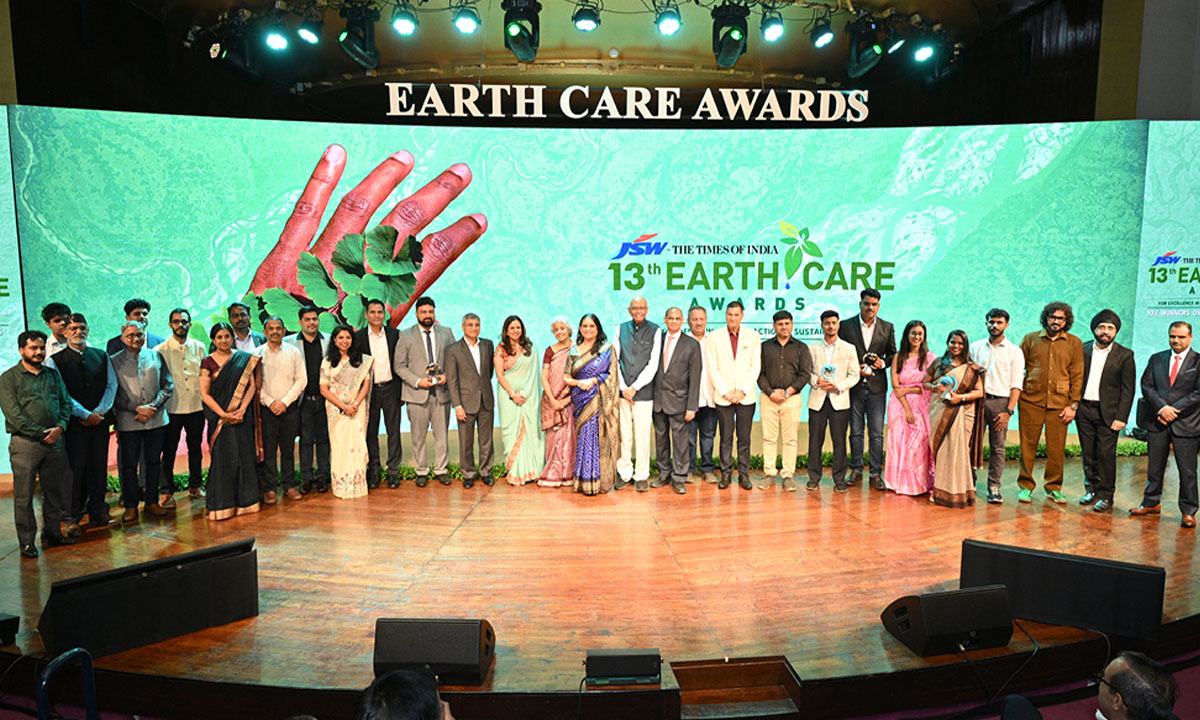
Since 2008, the JSW–Times of India Earth Care Awards have documented a quieter, more distributed story of climate action in India. The 13th edition, with six categories spanning communities, institutions, businesses, women leaders, communicators, and young innovators, offers the most comprehensive portrait yet of where Indian climate leadership is actually taking root.
India’s climate story is most often told through the lens of policy announcements and industrial decarbonisation commitments. The Earth Care Awards (ECA), instituted jointly by JSW Group and The Times of India in 2008, have spent 13 editions documenting a different and equally consequential story: one that originates in tribal forests, Himalayan watersheds, district collector offices, college campuses, and independent newsrooms.
That breadth is deliberate. The ECA’s six award categories are designed not to impose a single definition of climate leadership, but to recognise that the challenge is too wide for any one sector to address alone. As Mrs Sangita Jindal, Chairperson of the JSW Foundation, put it at the 13th edition ceremony, held at the Tata Theatre, NCPA: “Our mission with these awards is simple: find the people who are actually doing something: innovators, grassroots leaders, institutions that have put climate at the centre of what they do.”
Over 13 editions, that mission has produced a body of evidence. Taken together, the ECA’s recognition of 87-plus individuals and organisations constitutes something close to an annual census of on-the-ground climate action in India, mapping where innovation is concentrated, where governance is succeeding, and where the gaps remain.
The Community-Led Climate Action and Institutional Leadership categories sit at the foundation of the ECA’s framework, grounded in the recognition that durable environmental outcomes depend on local ownership and governance capacity.
This year, the Central Himalayan Rural Action Group (CHIRAG) was recognised for a science-backed spring-shed management model that restores Himalayan water sources and builds long-term water governance within rural communities. The model’s significance extends beyond its local impact: the ECA jury cited its ‘replicable pathway for government adoption’, a critical quality in a region where, according to a NITI Aayog report, approximately 50 million people depend on springs for their water supply, and nearly 50 per cent of those springs have recorded significant decline over the past two decades.
NIRMAN’s work adds another dimension to the community climate picture. By enabling tribal forest-dependent communities to secure legal tenure under the Forest Rights Act and govern their own forest landscapes, NIRMAN is operationalising what the IPCC’s Sixth Assessment Report identifies as a global best practice: community-governed forests consistently exhibit lower deforestation rates, higher biodiversity, and greater carbon sequestration than forests under centralised state control. This finding carries direct relevance to India’s NDC commitment to create an additional carbon sink of 2.5 to 3 billion tonnes of CO₂ equivalent by 2030.
Himmotthan Society was honoured for its integrated approach to climate resilience in fragile Himalayan landscapes, spanning water security, indigenous artificial glacier systems, fodder development, and community-led livestock management, a model that addresses livelihood and ecological stability as a single, inseparable challenge.
At the institutional level, Gram Panchayat Nanasa demonstrated how village-level governance can achieve water security through a self-initiated model that combined groundwater recharge with a culturally embedded behavioural innovation, sustaining community ownership of the programme. The Collector’s Office, Rajnandgaon, Chhattisgarh, received a commendation for systems-level district leadership: GIS-based hydrological planning, convergence financing, and a structural shift towards climate-resilient and diversified agriculture across an entire district.
The Emerging Business in Climate Action category reflects the ECA’s recognition that market-based innovation is a necessary, if insufficient, component of the climate transition. This year’s winner, Minimac Systems Pvt. Ltd., was recognised for developing a proprietary, multi-technology lubricant reconditioning system that addresses a high-volume industrial waste problem with a commercially scalable model and a credible pathway to full MacroCircularity.
The recognition of Minimac Systems points to a broader and underappreciated opportunity in India’s industrial economy: the intersection of waste management, resource efficiency, and commercial viability. The jury’s explicit citation of the model’s scalability signals what the ECA has consistently sought to reward: not climate action as a one-off gesture, but solutions designed from the outset to travel.
In a separate recognition, Mahindra Group received the Green Business Titan award for its long-standing sustainability commitment, adding a large-corporate dimension to the 13th edition’s otherwise predominantly grassroots and emerging-business cohort.
Two of the most distinctive recognitions in the 13th edition spoke to the roles that women and independent media play in sustaining climate ecosystems that policy and business alone cannot maintain.
Meera Chandran of Forest First Samithi was honoured under the Women Leaders in Climate Action category for a community-led forest restoration initiative in the Western Ghats that has earned judicial recognition and empowered tribal communities as primary agents of recovery. Her work embodies a form of environmental stewardship that combines scientific rigour with deep community accountability, qualities that institutional programmes frequently aspire to and rarely achieve.
Mongabay India, winner of the Communicators for Climate Action category (introduced in the 13th edition for the first time), was recognised for its rigorous, open-access environmental journalism published in English and Hindi. This recognition highlights making environmental science accessible to audiences ranging from policymakers to civil society, and for a consistent record of journalism that translates into real-world impact.
The Young Climate Champions Programme, which received over 750 submissions in the 13th edition, produced seven winners spanning the full breadth of the climate challenge.
Rajalakshmi Institute of Technology in Chennai was recognised for institutional leadership in green infrastructure and sustainable mobility. Arnav Garg of IIT Delhi won in the Clean and Renewable Energy Solutions category for an AI-enabled smart grid platform that advances renewable energy integration and demand forecasting. Jhansi Bhupendra Pulla of Pillai College of Arts, Commerce and Science created the ‘Pollinator Highway’, a biodiversity restoration model that uses native plantations and ecological corridors to support pollinator populations. Haridra Bora of Miranda House, University of Delhi, developed a climate-sensitive health risk mapping tool that strengthens early warning systems for mosquito-borne diseases. Arpit Kumar of Manipal Academy of Higher Education created MARU, a maintenance-free water purification technology for arsenic and heavy metal removal. T.K. Devanarayanan of NIT Calicut proposed a decentralised circular bio-refinery model that converts poultry and meat waste into biodiesel, bioplastics, and biogas. Rinku Pal of ABM College’s Vayuveer Programme addresses waste management and indoor air pollution in informal urban settlements through hyperlocal community action.
The collective profile of this cohort, spanning energy systems, biodiversity, public health, water, waste, and air quality, is itself a data point.
The addition of Young Climate Champions Programme to inspire Youth Champions for Climate Action consistently demonstrates, climate cannot be just a specialist field. It is a design problem that every age and discipline has a role in solving.
What the 13th Earth Care Awards demonstrate, across six categories and 13 editions, is that India’s climate leadership is neither concentrated nor singular. It is distributed across geographies, sectors, and scales, from a village panchayat in Rajasthan restoring groundwater to an IIT student in Delhi redesigning how electricity grids absorb solar and wind energy.
The ECA’s institutional value lies in making that distribution visible. As Ashwini Bhide, Municipal Commissioner of the BMC, noted in her keynote address at the 13th edition ceremony: “Climate responsibility lies not only with governments but also with citizens, institutions, NGOs, and organisations working together toward meaningful change.”
The awards do not merely honour that diversity. They document it, building, year by year, an evidence base for the proposition that India’s path to its 2030 climate commitments will be shaped as much by its grassroots innovators, community stewards, and young problem-solvers as by its industrial decarbonisation programmes. Recognising that reality, and creating a platform to amplify it, remains the Earth Care Awards’ most durable contribution.
View all newsBUSINESSES
JSW Steel JSW Energy JSW Infrastructure JSW Cement JSW Ventures JSW Paints JSW Realty JSW Defence JSW Dulux


